Recycling and Sustainability: Flat Clearance Alperton
![A row of three large wheeled rubbish bins positioned on a concrete surface in front of a building with corrugated metal siding. The bins are coloured yellow, blue, and green from left to right, each fitted with a black lid and handle, and appear to be made of durable plastic with a textured finish. The yellow bin is on the far left, the blue bin is in the middle, and the green bin is on the right, with slight differences in the positioning of their lids and handles. The background includes a partially visible roller shutter door above the bins, suggesting an industrial or commercial setting, possibly a waste collection point in a town near [POSTCODE] or [TOWN]. The scene is evenly lit, capturing the utilitarian environment typical for rubbish collection, associated with services offered by companies like Flat Clearance Alperton specializing in waste management and rubbish removal for local businesses or residents.](/pub/_photos/rubbish/f1296820432.jpg) When you choose Flat Clearance Alperton you are choosing a service that places the environment at the heart of every project. Our approach to an eco-friendly waste disposal area means that every flat clearance is planned to minimise landfill, maximise reuse and support the local boroughs' schemes for separation at source. We work with householders to identify items suitable for reuse, separation and specialist recycling so that the footprint of each job is reduced.
When you choose Flat Clearance Alperton you are choosing a service that places the environment at the heart of every project. Our approach to an eco-friendly waste disposal area means that every flat clearance is planned to minimise landfill, maximise reuse and support the local boroughs' schemes for separation at source. We work with householders to identify items suitable for reuse, separation and specialist recycling so that the footprint of each job is reduced.
We collaborate with borough-level waste strategies and reflect the local council's emphasis on glass, paper, mixed recycling and food waste streams. Our teams are briefed on the specific collection protocols across Brent and neighbouring boroughs, so removal and sorting conform with municipal expectations. This ensures that recyclable materials are not contaminated and can be processed correctly at the transfer station.
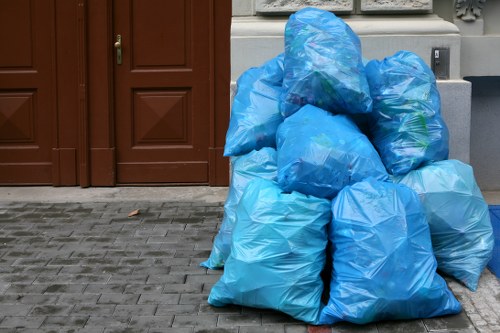 Our sustainability pledge sets a clear recycling percentage target: we aim for a minimum of 75% reuse or recycling on standard residential clearances by 2028, moving progressively toward higher rates each year. This target covers items diverted from landfill into repair networks, charity rehoming, metal and wood recycling, and specialist hazardous waste streams handled per regulation.
Local transfer stations and material flows
We use accredited local transfer stations to streamline the material flow from flat clearances into the proper processing channels. By routing collected items through nearby facilities we reduce haulage distances and make use of established sorting lines for plastics, paper, metals and construction waste. These transfer stations also enable efficient tracking of tonnes diverted from landfill.
Working within the London borough framework, our teams are trained on the nuances of kerbside and communal waste separation practices. Where borough policy encourages separate collections for textiles or small electrical items (WEEE), we ensure such items are boxed separately and logged for specialist processing rather than being placed in general refuse.
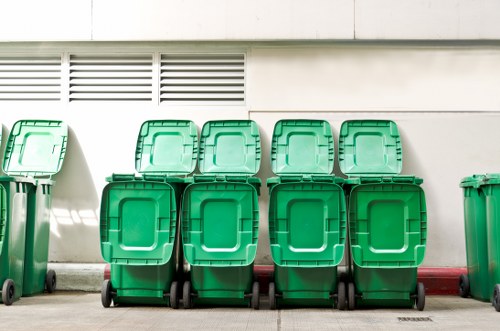 We maintain transparent reporting on tonnage and recovery rates so customers and community stakeholders can see the impact of sustainable flat clearances. Transparency supports continuous improvement, and our periodic reviews with transfer station managers help close feedback loops to improve sorting quality at source.
Partnerships with charities and community reuse
Partnerships with local charities are central to our reuse model. We coordinate with furniture banks, social enterprises and registered charities to donate usable household items. These partnerships ensure that furniture, kitchenware and small appliances that still have life are rehomed to families in need or to refurbishment projects supporting employment and training.
The partnership network extends to textile banks, book charities and community reuse hubs. Where full donations are not possible, items may be refurbished by social enterprises and sold in charity shops; proceeds support local programs. This approach of redirecting goods for social value complements the environmental objectives of a sustainable rubbish area approach in the city.
To support civic goals we also run regular donation drives and partner with collection days run by boroughs, ensuring that items like large furniture are transferred to charity partners with the right logistical support and documentation.
Our operational choices reduce carbon in two ways: fewer journeys due to better sorting and the use of low-carbon vans across our fleet. We deploy hybrid and electric vehicles where routes and charging infrastructure allow, cutting tailpipe emissions on dense urban circuits and improving local air quality in residential neighbourhoods.
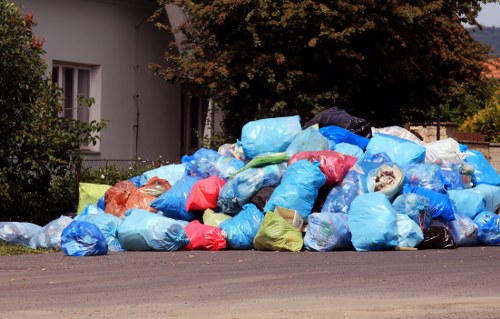 Route optimisation software and consolidated collection schedules mean fewer vehicle miles for each clearance, and where heavier items require specialist vehicles we use models with lower emissions per tonne moved. These steps are part of our broader carbon reduction plan that includes staff training on eco-driving and load efficiency.
 As part of improving circularity in Alperton, we provide clear guidance on what can be separated at source and how we handle specialist streams such as electronics, batteries and hazardous household chemicals. Items unsuitable for donation are processed by authorised recyclers to recover materials and neutralise environmental harm.
In summary, our commitment to sustainable flat clearance in Alperton combines measurable targets, local transfer station partnerships, charity collaborations, and a low-carbon transport strategy to support a resilient, eco-friendly waste disposal area. Choosing our services contributes to a cleaner neighbourhood, higher reuse rates and a stronger local circular economy.
- Recycling target: 75% reuse/recycling target on standard clearances by 2028.
- Local infrastructure: Use of accredited transfer stations and borough-aware sorting.
- Charity partners: Furniture banks, textile charities and social enterprises for reuse.
- Low-carbon fleet: Hybrid and electric vans, route optimisation and eco-driving training.
- Compliance: Proper handling of WEEE, batteries and household hazardous waste in line with regulations.
Flat clearance services in Alperton should be more than a removal—when done responsibly they help create a sustainable rubbish area, support vulnerable residents through donations and reduce the overall environmental burden on the borough. Our model is designed to be practical, measurable and aligned to local sustainability goals.
Flat clearance in Alperton is evolving: as recycling infrastructure improves and low-emission transport becomes more accessible, we will scale our commitments and continue reporting progress so the community can see the positive outcomes of each clearance.